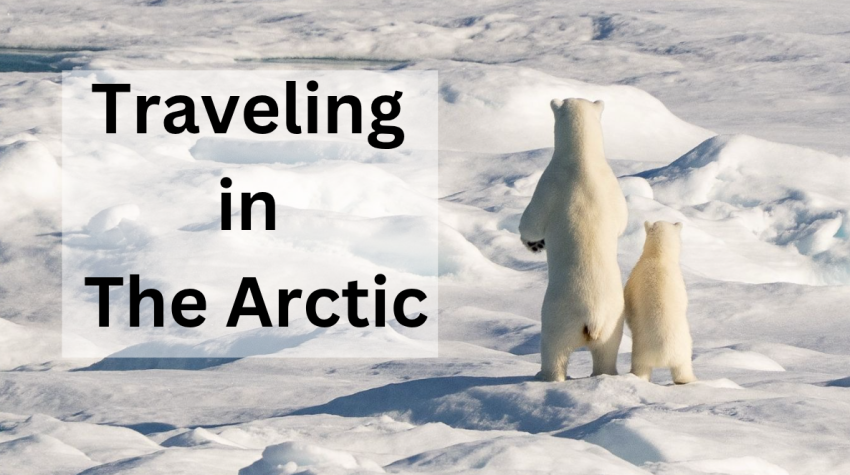
It was a spontaneous decision.
“Let’s Go To The Arctic!”
My wife and I were on our way home last summer from a Disney Cruise we took with our daughter and granddaughter. The cruise was great, but the cacophony of excited children grated a bit on our aging nerves. As we were driving home, we discussed our mutual desire for a vacation “Just For Us.” We realized we both had the same desire to spend some time above the Arctic Circle.
After a few weeks of research, we booked a Viking Cruise for August 2025 (they don’t allow children on their cruises). The “Expedition Cruise” took place on a polar-rated ship and spent 2 weeks above the Arctic Circle, along the coast of Greenland, and into the Northwest Passage. Here’s an overview of the cruise route:
We just got home from the cruise. It was one of the best vacations we’ve ever taken.
Today, I’ll tell you about it. And…I’ll share a lot of photos.
Hint: Yes, we saw polar bears.
We just got back from 2 weeks above the Arctic Circle. Want to see what it looks like? Share on X
Standing at the entrance to The Northwest Passage
It isn’t easy to get to Greenland.
While the capital city of Nuuk recently expanded its runway to 6,600 feet in length (allowing international jets to land), there are very few flights from the USA. To accommodate the 300+ passengers on our cruise, Viking hired a Charter jumbo jet to fly us all directly from NYC, along with all of the supplies necessary for our voyage (we had marvelous fresh fruit and sushi throughout our trip). An interesting and efficient solution to a difficult-to-service embarkation port. We all flew into NYC, were transported to a nearby hotel for the evening, and set our alarms for 2:15 a.m. to catch our early morning departure to Greenland.
Nuuk was fogged in.
As we approached Nuuk after our 4-hour flight from NYC, we were advised that Nuuk was fogged in and we would have to divert 200 miles to Kangerlussuaq Airport, originally an air force base and one of the only runways in Greenland long enough to land our plane. After sitting on the ground for 3+ hours, we resumed our journey, landed in Nuuk, and were transported to the ship via bus.
In total, it was 30 hours door-to-door.
It isn’t easy to get to Greenland.
In spite of that, it’s an amazing country and well worth a visit. I expect you’ll see a surge of cruises working out of Nuuk in the coming years, and an increase in commercial airline traffic to support the growing tourism industry. FYI, Greenland is a huge country, as illustrated by this overlay on the USA:
Below are highlights from the trip, starting with the vessel we traveled on:
The Ship
The Viking Octantis
The Viking Octantis is a 665 ft long Polar Class 6 vessel, designed for travel in polar regions. In the winter, it travels to Antarctica, across the infamous Drake Passage. She’s tough, but designed for luxury travel. My favorite part of the ship is The Aula auditorium, an engineering marvel with retractable screens that reveal an amazing 270-degree view of the waters behind the ship. Throughout the trip, we enjoyed lectures from polar experts, Inuit “Cultural Ambassadors,” and daily briefings on our upcoming ports of interest.
The Aula (photo & description courtesy of Viking website)
We were allowed to tour the bridge of the Octantis, a modern-day wonder of technology for travel in some of the world’s most dangerous waters:
The bridge of The Octantis
The Toys
The ship also carries all of her own “toys”, including kayaks, Zodiacs, two submarines, and Special Operations Boats to transport and entertain guests in the various locations we visited. We toured “The Hanger” during the cruise, and were in awe of the thinking that went into its design.
The Hanger where all the toys live.
My wife and I kayaking above The Arctic Circle.
My wife on a Zodiac as we entered Sismiut, Greenland
The Inuit – Indigenous People of The Arctic
Inuit elders in traditional dress (note the sealskin boots)
One of my unexpected pleasures of the trip was learning about the Inuit culture (they’re not called Eskimos anymore). These are rugged people who live in one of the most inhospitable parts of the world, and comprise the vast majority of the local population (there are 57,000 people in Greenland, about 12% of whom are Danish). In addition to presentations from the Cultural Ambassadors aboard the ship (one of whom was a local high school teacher on her summer break), we were greeted warmly by the Elders in several of the fishing villages we visited on our cruise.
In addition to performing local songs and dances, the elders displayed traditional attire, explained a bit about their culture, and answered every question asked by the curious tourists. In one town, they demonstrated local sporting competitions, which included fascinating techniques of kicking a piece of bone hanging at various heights from a rope. They’re a very soft-spoken people, often assumed to be shy due to their soft voices and focus on communal (versus individual) needs. Theirs is primarily a subsistence hunting culture, though they welcome the growth of tourism and view it as a means to educate outsiders about their unique lifestyle (not to mention the economic boost to their local economy).
Greenlandic homes are colorful, as illustrated in this photo from Sismiut:
The colorful homes of Sismiut, Greenland
In one village, we were invited into an individual’s home for “Kappemik” (local coffee and danishes, baked by the women of the community before our arrival). It was fascinating to spend time inside a “local’s” home, and imagine what their life must be like in such remote communities far above the Arctic Circle.
Hint: The Inuit don’t like their pictures being taken, so always ask for permission first (the elders in the photo above invited us to take that picture, it’s the only picture of Inuit I took the entire trip)
The Scenery
It’s hard to describe how wild Greenland and Nunavut, the Northernmost province of Canada, really are. The western coast of Greenland is the most beautiful coastline I’ve ever seen. With 80% of the country covered by an ice sheet, I can only imagine how remote and wild the interior is. There are over 150 named fjords in Greenland (and countless unnamed ones), most of which terminate with a glacier. Here’s one example:
A Greenland glacier (note Zodiacs in the foreground)
The town of Ilulissat (which in Inuit means “Iceberg”) sits where the Ilulissat Icefjord (a UNESCO World Heritage Site) runs from the interior ice field to the sea. A bit of trivia – the iceberg that sank the Titantic was deposited in the sea from this icefjord. I can’t even begin to describe the scale of the icefjord – note the people in the bottom of this picture for scale:
The Ilulissat Icefjord (note people at bottom for scale)
I took a 5-mile hike from the town to an awe-inspiring overlook of the icefjord. It was worth every step:
A rock cairn marks the trail along the icefjord
The Entrance To The Northwest Passage
After a week cruising the western shore of Greenland, we were excited to enter the infamous Northwest Passage, where we spent the second half of our journey. No article about traveling in the Arctic would be complete without a photo showing the entrance to the famous waters in the Canadian province of Nunavut:
The entrance to the Northwest Passage.
The Furthest Point North – Beechey Island
One of the highlights of the trip was a visit to Beechey Island, 562 miles above the Arctic Circle (for the record, it’s at 74.7° North and has 6 weeks of 24-hour daylight). Sadly, it’s also the final resting place for three members of the failed Franklin Expedition in 1845*. This map gives you a sense of how far North we were:
Here are a few photos from Beechey Island:
The desolate (and cold, windy) shores of Beechey Island, 560 miles above the Arctic Circle
The Final Resting Place for 3 members of the failed Franklin Expedition
* Side note: Read some books before you go. I benefited greatly by reading Across The Top of The World (Amazon Affiliate link) before our departure, an amazing book about the early expeditions in search of the Northwest Passage, including a chapter on the doomed Franklin Expedition.
The Polar Bears
We visited Beechey Island early in the morning.
Why? Because we needed the rest of the day to go “hunting.” Based on ice maps the crew studied daily, they knew there was a large swatch of sea ice nearby. From experience, they knew that’s where the polar bears would be. Even in the summer, the polar bears use the sea ice to hunt for seals.
Mom is concerned about a nearby male hunting her cub (males eat cubs!)
We had a successful “hunt.”
We spotted 6 polar bears, and savored every minute watching them in their natural environment. The highlight was watching a Mom with her cub as they faced a life-threatening male, which are known to eat cubs. We were spellbound by the drama and watched as Mom and cub ultimately jumped in the water and swam 500 yards to move downwind from the male, who (fortunately) missed his snack.
By the time the day was done, even the ship’s crew was excited by the results. “I’ve been traveling to the Arctic for years, and you just don’t see them this close!” Yes, it was that good. We all took photos with our cell phones, but I’m pleased to share some professional photos with you (thanks to John Chardine, a retired research scientist who was a guest speaker on the ship and permitted me to use his photos – he took them while we were standing next to each other on the deck of the boat. Check out his photography site here).
The first bear we spotted, a big (and curious) male.
Big male, trying to find the cub.
Mom & Cub swimming to safety
I took this one with my cell phone.
Conclusion
The trip is one my wife and I will never forget. Sure, it cost a lot of money, but creating special memories is an investment I’ll never regret in these few short years we have to live our dream lives. How much did we enjoy it? Enough that we’ve already booked a second Expedition Cruise with Viking. In November 2027, we’ll be sailing The Octantis to Antarctica.
We can’t wait.
Long-time readers know I’ve been struggling to spend in retirement. The good news? I’m getting better at it. I recently wrote a LinkedIn post, which summarizes my thoughts on our trip and is an appropriate conclusion for today’s post.
After we retire, what’s the best use of our money?
Once your basic needs are covered, give yourself permission to spend (within safe limits) on creating memories. In time, those memories will become your greatest investments.
I returned last night from an (expensive) 2-week Expedition to Greenland and The Northwest Passage.
The value of watching polar bears (including this mom and her cub) live in their natural environment, 500 miles North of The Arctic Circle?
Priceless.
Life is short. Invest in making new memories, while you still can.
#NoRegrets
P.S. If you enjoyed this “travel blog” article, you may be interested in the following summaries of every major trip we’ve taken since my retirement in 2018:
Your Turn: What’s the best vacation you’ve ever taken, and why? Have you ever considered traveling in the Arctic? Want to join us in Antarctica? Let’s chat in the comments…